
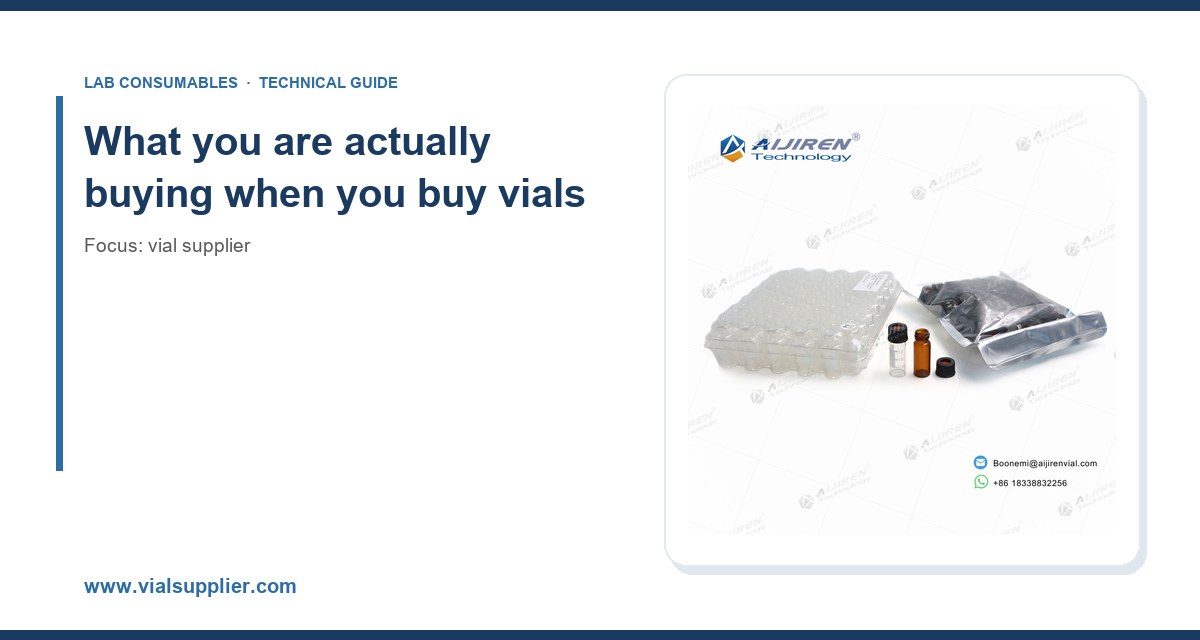
I have bought vials in quantities ranging from two cases of 2 mL autosampler glass to a 40-foot container of 20 mL headspace crimp vials, and I have been burned by cheap glass more than once. The first time I approved a low-bid supplier without asking for a dimensional report, we lost three days of GC runs to a batch of vials with neck IDs that varied by 0.4 mm. The autosampler gripper dropped roughly one vial in forty. That is the kind of lesson that makes you write a procurement spec instead of trusting a price sheet. This article is the spec I now use, and the questions I ask before I sign a purchase order.
A vial is not a commodity in the way a cardboard box is. It is a precision glass or plastic component that has to interface with a septa, a crimp or screw cap, an autosampler gripper, and a detector that may be looking for a 2 µL peak. The dimensional tolerances on the neck, the wall thickness, the base flatness, and the closure torque all affect whether your data is good. When a supplier quotes you a price per thousand, they are quoting a bundle of tolerances. Your job is to find out which ones they hold and which ones they quietly let drift.
The main categories you will be sourcing are:
- 2 mL autosampler vials in 12 x 32 mm format, the workhorse of HPLC and GC autosamplers. Glass or plastic, crimp or screw top, with or without a fused insert.
- 4 mL and 10 mL screw-thread vials for larger injection volumes and for ICP-MS and IC work.
- 20 mL headspace crimp vials with 20 mm crimp closures, used with headspace samplers.
- 40 mL volatile organic analysis (VOA) vials for EPA methods, with septum-lined screw caps and a specified septa material.
- Amber and clear glass in both borosilicate (Type I) and soda-lime (Type III), which matters for pH-sensitive analytes and for leachables.
- Inserts (250 µL, 150 µL, pulled-point or conical) for small-volume injections.
Each of these has its own tolerance stack. A supplier who is excellent at 2 mL crimp vials may be mediocre at 20 mL headspace vials. Do not assume a single approved vendor covers your whole catalogue.
Pricing: what drives the number on the quote
Vial pricing is driven by glass type, closure, packaging, and volume. I have watched 2 mL clear glass screw-thread vials with PTFE/silicone septa move between $0.09 and $0.22 per unit depending on quantity, closure quality, and whether the caps are pre-assembled. The gap between the low and high end is not marketing. It is dimensional control, glass chemistry, and the cost of the septa.
The cost stack, from cheapest to most expensive
- Glass body: soda-lime is cheaper than borosilicate. For most reversed-phase HPLC at neutral pH, soda-lime is fine. For ion chromatography, trace metals work, or anything where you worry about sodium and boron leaching, specify Type I borosilicate.
- Closure: a polypropylene screw cap is a few cents. A cap with a bonded PTFE/silicone septum costs more, and a cap with a molded-in septum costs more again.
- Septa: silicone is cheap and has good reseal, PTFE is chemically inert but has poor reseal, and a PTFE-faced silicone laminate is the common compromise. A pure PTFE septum on a 2 mL vial is a bad idea for repeated injections because it cores and leaks.
- Packaging: vials in a partitioned tray with a cleanroom bag cost more than vials in a poly bag. If you are running trace analysis, the packaging is part of the product.
- Certification: a certificate of analysis with dimensional data and a leachables panel adds cost. So does a lot-traceable cleanroom pack.
Price per unit is not price per injection
Here is the calculation that changes the conversation. Suppose Supplier A quotes $0.11 per 2 mL screw vial and Supplier B quotes $0.16. On the surface A wins by 45%. Now assume A has a 2% autosampler reject rate and B has 0.2%. On a 96-vial tray, A loses about two vials per tray and B loses about one in five trays. If a failed injection costs you a rerun, and a rerun on an LC-MS/MS costs you instrument time and a technician’s attention, the 5-cent difference disappears fast. I have seen a 3-cent-per-vial saving turn into a 15% increase in cost per usable injection once reject rates and reruns were counted.
Ask every supplier for their autosampler reject rate on the last three lots, and ask how they measure it. A supplier who cannot answer has not measured it.
MOQ: how to read the number and negotiate around it
Minimum order quantity is where procurement and lab reality collide. A supplier’s MOQ is usually set by their packaging run, their glass molding batch, or their distributor agreement. A glass plant may run a minimum batch of 10,000 to 50,000 units per colour and format. A distributor may break that down to one case of 100 or 1,000, at a markup.
What I do:
- Separate MOQ from price break. A supplier may have an MOQ of 1,000 but a price break at 10,000. Ask for the full price ladder, not just the MOQ price.
- Ask what the MOQ is per SKU. A 10,000-unit MOQ across a mixed pallet of five SKUs is very different from 10,000 per SKU.
- Check the closure MOQ separately. Caps and septa often have their own MOQ, and pre-assembled caps can push the effective MOQ up.
- Ask about stock vs made-to-order. A distributor holding stock can ship 500 units tomorrow. A factory making to order needs a batch. If you need 500 units urgently, you are buying from stock, and you pay for that convenience.
For a lab running 200 injections a week, a 10,000-unit order is roughly a year of vials. That is fine if the vial is stable on the shelf and the closure does not degrade. It is not fine if you are still validating a method and the vial format may change. Buy the small pack first, validate, then commit.
How to evaluate a vial supplier: the audit checklist
I evaluate suppliers on five axes: dimensional control, glass chemistry, closure and septa quality, packaging and cleanliness, and documentation. Here is the checklist I actually use, with the numbers I expect.
1. Dimensional control
The 12 x 32 mm format is defined by the autosampler, not by the supplier. Ask for a dimensional report on the last lot with these measurements:
- Outer diameter: 12.00 mm nominal, tolerance typically ±0.2 mm. Tighter is better for gripper reliability.
- Height: 32.00 mm nominal, tolerance ±0.3 mm. Height variation causes needle-depth problems on fixed-height autosamplers.
- Neck OD and ID: this is where cheap glass fails. A neck ID that varies by more than 0.2 mm across a lot will cause crimp cap seating problems and septa coring.
- Base flatness: a rocking vial sits crooked in the tray and the needle can bend.
I ask for a capability index (Cpk) of at least 1.33 on the critical dimensions. A supplier who sends a report with only nominal values and no distribution has not measured anything useful.
2. Glass chemistry and leachables
For trace analysis, the glass matters. Type I borosilicate has a lower alkali leach rate than Type III soda-lime. If you are running EPA SW-846 methods for volatiles or semivolatiles, the vial and septum are part of the method. The U.S. EPA SW-846 test methods for waste and materials specify vial and septum requirements for several procedures, and you should match the vial to the method rather than to the price. Ask for a leachables extract report on the glass lot if you are doing trace metals or ion work.
3. Closure and septa quality
This is where I see the most variation between suppliers. A cap is a molded part, and the thread engagement and the septa bond are what keep your sample sealed. Ask:
- Is the septum bonded or loose? Bonded septa do not fall out in the autosampler. Loose septa are cheaper and fail more.
- What is the septa material and thickness? A standard 2 mL screw cap uses a 1.0 mm PTFE/silicone septum. Headspace vials use a thicker 3.0 mm septum for pressure cycling.
- How many punctures before failure? A good PTFE/silicone septum holds 5 to 10 punctures before coring becomes a problem. A pure silicone septum reseals better but is not solvent-resistant. A pure PTFE septum cores early and should be replaced after 1 to 2 punctures.
- What is the recommended crimp torque or crimp dimension? For 20 mm crimp vials, the standard is a crimp that seats the seal without crushing the neck. Ask the supplier for their crimp dimension spec and check it against your crimper’s setting.
If you are running HPLC, the septa and the frit in your inline filter are both contamination sources. The HPLC filter side of the flow path and the vial side are the two places I check first when I see ghost peaks.
4. Packaging and cleanliness
Vials arrive in trays, bags, or boxes. For trace work, ask for:
- Cleanroom packing at ISO Class 8 or better for trace metals and LC-MS work.
- Partitioned trays so vials do not rub against each other in transit. Glass-on-glass contact creates micro-scratches that shed particles.
- Double-bagged packaging with a desiccant for humidity-sensitive septa.
I have opened a case of vials that arrived in a single poly bag with no partition and found glass dust in the bottom. That dust goes straight into your mobile phase. Packaging is a quality control step, not a shipping detail.
5. Documentation and traceability
Ask for a certificate of analysis with the lot number, the dimensional data, the glass type, the septa material, and the date of manufacture. Ask whether the supplier can trace a vial back to the glass batch and the molding run. If the answer is no, you are buying an anonymous product, and if a method fails you have no way to investigate.
A comparison checklist with concrete numbers
Here is the table I use when I score two or three suppliers side by side. The weights are mine; adjust them to your lab.
- Dimensional Cpk on neck ID: target 1.33 or better. Weight 20%.
- Autosampler reject rate: target under 0.5%. Weight 20%.
- Septa puncture count before coring: target 5 or more for PTFE/silicone. Weight 15%.
- Glass type and leachables report: Type I borosilicate with extract data for trace work. Weight 15%.
- Packaging cleanliness: ISO Class 8 cleanroom pack and partitioned trays for trace work. Weight 15%.
- Documentation and lot traceability: CoA with dimensional data and batch trace. Weight 15%.
Score each supplier out of 100. A supplier who scores 85 with a 12-cent vial usually beats one who scores 60 at 9 cents. I have run that math enough times to trust it.
Operational precautions before you commit
Before you place a large order, run these checks:
- Run a 96-vial autosampler test on the candidate lot and count rejections. Do it on your own instrument, not the supplier’s demo unit.
- Run a blank injection from ten vials across the lot and look for ghost peaks at your analyte retention times. This catches leachables and septa contamination.
- Check crimp or screw torque on a sample of caps with a torque tester. For screw caps, the typical target is 1.0 to 1.5 N·m for a 9 mm screw thread, and you should confirm the supplier’s recommended value. Over-torque deforms the septum and causes coring.
- Verify the GPI thread finish if you are buying screw-thread vials. The Glass Packaging Institute (GPI) defines the 9 mm and 13 mm thread finishes, and a vial that does not match the GPI finish will not seal with a standard cap. Ask the supplier to confirm the GPI thread designation.
- Confirm the septa are lot-matched to the caps. A mismatched cap and septa combination is a common source of leaks.
Troubleshooting checklist
When a vial-related problem shows up, work through this list in order:
- Ghost peaks or carryover: check the septa first. A coring PTFE septum sheds particles that sit in the needle. Then check the PTFE membrane filter in your sample prep, because a clogged filter can concentrate contaminants.
- Autosampler gripper drops: measure the outer diameter and height on ten vials from the lot. Variation beyond ±0.2 mm on OD is the usual cause.
- Leaks or evaporation: check the cap torque and the septa thickness. A 1.0 mm septum on a headspace vial is the wrong part.
- Needle bending: check base flatness and height variation. A rocking vial bends needles.
- Trace metal contamination: check the glass type and the packaging. Soda-lime glass in a poly bag is not a trace-metal vial.
- Inconsistent retention times: check for vial-to-vial volume differences and septa leaks. A leaking septum changes the headspace and the injection.
When I need to cross-check a method or a consumable spec, I go to the vendor technical libraries. Agilent chromatography consumables and columns and Thermo Fisher chromatography and sample handling both publish dimensional and compatibility data that is useful when a supplier’s spec sheet is thin. Restek technical resources for chromatography has good guidance on septa selection and injection technique.
Where to buy and how to structure the relationship
You have three routes: a factory-direct supplier, a distributor, and a marketplace. Factory-direct gives you the best price at volume and the most control over specs, but the MOQ is high and the lead time is long. A distributor gives you small quantities and fast shipping at a markup. A marketplace gives you price transparency and no accountability.
My recommendation for a lab running routine work: qualify one factory-direct supplier for your high-volume 2 mL format and one distributor for everything else. Keep a second factory-direct supplier qualified as a backup, and re-qualify every 12 months with a 96-vial autosampler test and a blank injection check. If you are sourcing across a network of labs, centralize the spec and let each site order against it. The vial supplier page on this site is a starting point for the catalogue, and the lab chromatography resources cover the method side of the same decision.
Concrete parameters to put in your purchase order
- Format: 12 x 32 mm, clear Type I borosilicate, 2 mL nominal.
- Dimensional tolerance: OD 12.00 ±0.2 mm, height 32.00 ±0.3 mm, neck ID Cpk ≥ 1.33.
- Closure: 9 mm screw thread per GPI finish, polypropylene cap with bonded 1.0 mm PTFE/silicone septum.
- Septa performance: 5 or more punctures before coring, no visible coring at 10 punctures.
- Packaging: partitioned tray, double-bagged, ISO Class 8 cleanroom pack for trace work.
- Documentation: CoA per lot with dimensional data, glass type, septa lot, and date of manufacture.
- Acceptance test: 96-vial autosampler run with reject rate under 0.5%, plus blank injection check.
Takeaway
Vial procurement is a tolerance decision disguised as a price decision. The number on the quote tells you almost nothing until you know the dimensional Cpk, the septa puncture count, the glass type, and the packaging. Ask for the data, run the 96-vial test on your own instrument, and score suppliers on the checklist rather than on the unit price. A vial that costs 4 cents more and rejects one in five hundred is cheaper than the one that costs 4 cents less and rejects one in fifty. Buy the spec, not the price sheet.
References & further reading
Related resources from our lab consumables network:
- Vial Supplier at vialsupplier.com
- Lab Chromatography at labchromatography.com
- Hplc Filter at hplcfilters.com
- Ptfe Membrane Filter at ptfemembranefilter.com
External references and standards: