
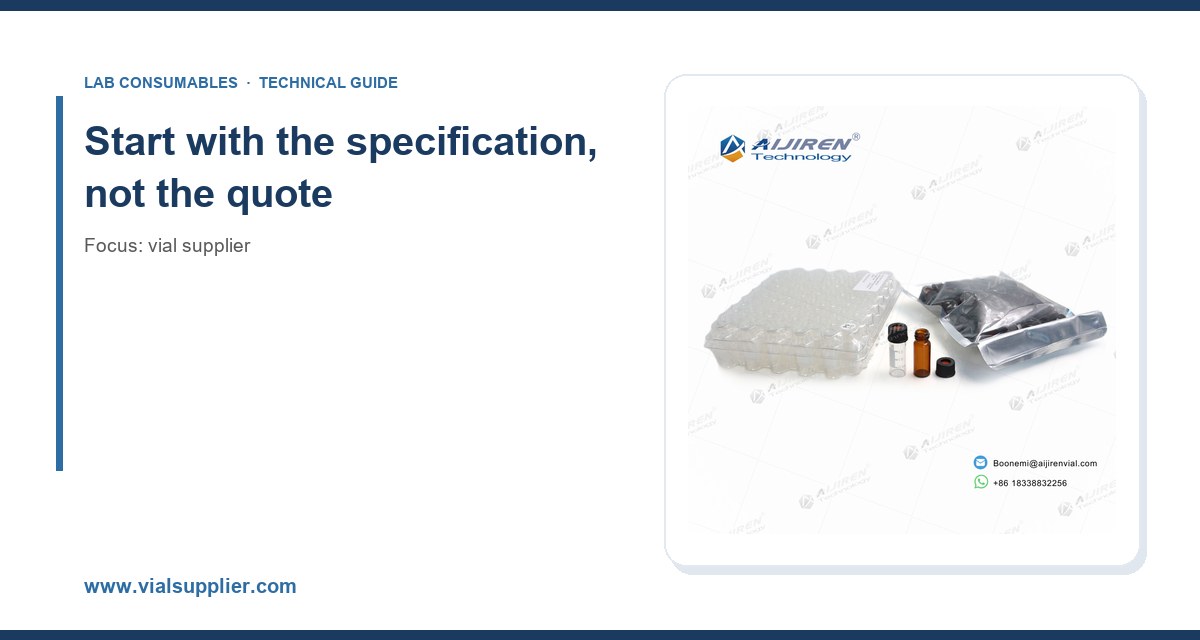
I still remember the first pallet of vials I ever rejected. Twelve thousand 2 mL clear glass vials, 9 mm screw thread, ordered at what looked like a great unit price. They arrived with thread dimensions that drifted outside GPI 9-425 tolerances, and about one in forty caps cross-threaded on our filling line. We ate the freight, ate the restocking fee, and lost three days of production. That was the day I stopped treating vial procurement as a price-per-thousand exercise and started treating it as a specification and supplier-qualification problem.
If you are buying vials in any volume, whether that is a few cases of 12 x 32 mm autosampler vials or a full truckload of 20 mL headspace vials, the same three questions decide whether you save money or lose it: what exactly are you buying, what is the true landed cost, and can the supplier prove they can hit the spec every time. This is how I evaluate vial suppliers now, with the numbers I actually use.
Most procurement disputes about vials trace back to a vague purchase order. “2 mL clear vial, 9 mm screw top, with caps” describes about six different products with wildly different performance. Before you talk price, write a spec that a supplier cannot interpret loosely.
What a vial spec sheet should pin down
- Nominal volume and working volume. A 2 mL vial is not a 2 mL fill. Standard 12 x 32 mm autosampler vials hold roughly 1.5 mL to a safe fill line; the 2 mL figure is total capacity to the shoulder.
- Physical dimensions with tolerance. For autosampler vials, 12 x 32 mm with a body OD tolerance of ±0.2 mm and a height tolerance of ±0.3 mm is a reasonable floor. Tighter tolerances cost more but matter on older autosamplers with worn grippers.
- Thread standard. For 9 mm screw thread, specify GPI 9-425 explicitly. For 13 mm and 18 mm closures, name the GPI thread finish. GPI (Glass Packaging Institute) thread finishes are what cap manufacturers build to; if the vial thread drifts, caps leak or cross-thread.
- Glass type. USP Type I borosilicate (expansion coefficient roughly 3.3 x 10⁻⁶/°C) for anything pH-sensitive, anything going into a autosampler with a needle, and anything stored long term. Type II treated soda-lime is acceptable for some aqueous buffers. Type III soda-lime is fine for short-contact, non-critical work and costs noticeably less.
- Color and UV transmission. Amber glass for light-sensitive analytes. Ask for the transmission curve, not just the word “amber.”
- Closure system. Septa material (silicone, PTFE-faced silicone, butyl, natural rubber), liner thickness (typically 1.0 mm or 1.3 mm for 9 mm caps), and cap material (polypropylene, phenolic, aluminum).
- Cleanliness grade. “Unwashed,” “washed,” “certified low particulate,” or “LC-MS grade.” This is where the price spread lives.
If you are running LC-MS at trace levels, the cleanliness grade is not optional. I have seen unwashed vials contribute extractable peaks in the 50 to 200 ppb range that ruined a method’s lower limit of quantification. For that work, buy certified vials, and buy them from a supplier who will give you the certificate with the lot number.
How pricing actually works in the vial supply chain
Vial pricing is not one number. It is the sum of glass cost, closure cost, washing and packaging cost, and the margin structure of whoever you are talking to. Understanding the layers tells you where you can negotiate and where you cannot.
The four cost layers
Glass. Type I borosilicate glass is the dominant cost driver. A 2 mL clear Type I vial from a primary manufacturer runs in the range of a few cents to maybe 15 cents per unit at high volume, depending on tolerance and cleanliness. Amber adds a premium. Larger formats, like 20 mL headspace or 40 mL EPA vials, scale roughly with glass mass.
Closures. A 9 mm screw cap with a PTFE-faced silicone septum is often 40 to 60 percent of the per-unit cost of a capped vial. This surprises people. The cap and septum are not an afterthought; they are a significant fraction of the bill, and they are where a lot of the quality variance lives.
Washing and certification. Certified vials can cost two to four times the unwashed equivalent. You are paying for validated cleaning, particulate testing, and lot-level documentation. Buy it only when your method needs it.
Channel margin. A distributor adds 15 to 35 percent over the primary manufacturer’s price, depending on volume and whether they hold stock. That margin buys you local inventory, smaller order quantities, and one invoice for vials, caps, filters, and syringes.
Price benchmarks you can use to sanity-check a quote
I will not quote you a fixed price because glass pricing moves with energy costs and freight, and the format matters enormously. But you can benchmark a quote against these ratios:
- A capped 2 mL screw vial should not cost more than about 2.5 times the uncapped vial from the same supplier. If the gap is larger, you are paying too much for the closure.
- Certified vials should be roughly 2x to 4x the unwashed price. If a supplier quotes certified at 1.2x, ask what “certified” means to them, because it probably means “we rinsed them.”
- Amber Type I should be within 10 to 25 percent of clear Type I. A larger premium usually means you are being quoted a different glass type.
- 13 mm and 18 mm closures cost more per unit than 9 mm. If a supplier quotes them at the same price, check whether they substituted a thinner septum.
When you compare quotes, compare landed cost: unit price plus freight plus any minimum-order surcharge plus the cost of your receiving inspection. A supplier who is two cents cheaper per vial but ships from overseas with a six-week lead time and inconsistent thread tolerances is not cheaper.
MOQ: what is reasonable and where it is negotiable
Minimum order quantities in the vial world are driven by packaging, not by manufacturing. Vials ship in cases of 100, 200, or 1,000 depending on format. The MOQ a supplier sets usually reflects what they can break from a master carton without repacking labor eating the margin.
Typical MOQ ranges I see in the market
- 2 mL autosampler vials: MOQ of one case (100 or 200 vials) is common from distributors. Direct from a primary manufacturer, expect 10,000 to 50,000 units, or a full pallet.
- 20 mL headspace vials: MOQ of 100 to 1,000 from distributors; 5,000 to 20,000 direct.
- 40 mL EPA vials (volatile organics): often sold in cases of 72 or 100. Direct MOQs run higher, sometimes a full pallet of 1,000 or more.
- Certified or custom-printed vials: MOQ climbs fast. Custom printing or special septa can push MOQ to 25,000 or more because of setup costs.
MOQ is negotiable when the supplier has the stock on the shelf and you are buying a standard catalog item. It is much less negotiable when you want a non-standard septum, a custom cap color, or a private-label print. If you need a low MOQ on a standard item, buy through a distributor who stocks it rather than trying to get a manufacturer to break a pallet.
One practical trick: if you are a multi-site lab, aggregate your vial demand across sites for a quarter and negotiate one PO. I have seen a five-site operation move from case-level MOQs to pallet pricing and cut unit cost by 18 percent, simply by consolidating.
How to evaluate a vial supplier: a working checklist
This is the checklist I run before adding any vial supplier to an approved list. It is not exhaustive, but every item on it has caught a problem for me at some point.
1. Quality system and documentation
- Do they hold ISO 9001? For anything pharmaceutical-adjacent, look for ISO 15378 (GMP for primary packaging materials).
- Can they supply a Certificate of Analysis per lot, with dimensional data and, for certified vials, particulate and extractable results?
- Do they have a Certificate of Conformance template that names the standard (GPI thread finish, USP glass type, dimensional tolerances)?
- Will they share extractable study data for their certified vials? If they will not, treat “certified” as marketing.
2. Dimensional consistency
Ask for a dimensional capability study. I want to see Cpk of at least 1.33 on critical dimensions: body OD, height, and thread finish. If they cannot produce that, buy a sample and measure it yourself with calipers on 30 to 50 vials. A thread that drifts by 0.1 mm will cross-thread on a capping head running at 60 caps per minute.
3. Closure performance
- Seal integrity. Ask for a leak test result. For screw caps, a dye penetration or pressure decay test at the supplier’s specified torque is standard.
- Torque specification. For 9 mm screw caps, typical application torque is 0.5 to 1.0 N·m; for 13 mm, roughly 0.8 to 1.5 N·m; for 18 mm, 1.2 to 2.0 N·m. Ask the supplier what torque their cap is designed for and whether their septum compresses correctly at that torque.
- Puncture count. For septa used with autosamplers, ask for the puncture count the septum is rated for before coring or leakage. A good PTFE-faced silicone septum should survive 50 to 100 punctures with a 22-gauge needle without coring. If a supplier cannot give you a number, assume 20 and plan your needle changes accordingly.
- Temperature rating. Silicone septa are good to about 200 °C short-term; PTFE-faced silicone is similar; butyl is lower. If you are doing headspace at 150 °C, confirm the septum rating in writing.
4. Cleanliness and background
For trace analysis, request a background mass spectrum or at minimum a total extractables number from a certified lot. I look for total extractables below 5 ppm for LC-MS grade vials. If the supplier cannot provide it, run your own: fill 10 vials with your mobile phase, sonicate 30 minutes, and inject on your system. Compare against a freshly cleaned vial from your current approved supplier. This is a two-hour test that has saved me from a bad lot more than once.
If you are running HPLC, the vial is only one part of the flow path. The mobile phase filtration and the sample prep consumables matter just as much. For filtration, I keep a stock of HPLC filter products on hand, and for aggressive solvents I use a PTFE membrane filter because it is chemically inert across the solvents I run. A vial with a clean background is wasted if the filter upstream is shedding particles.
5. Supply chain reliability
- Lead time. Standard catalog vials from a domestic distributor should ship in 1 to 5 business days. Direct from a manufacturer, expect 2 to 6 weeks. Overseas, 6 to 12 weeks plus customs.
- Stock visibility. Can they tell you, on the phone, how many cases they have on the shelf right now? If not, they are drop-shipping and you have no visibility.
- Lot traceability. Every shipment should carry a lot number that traces to a manufacturing date and a glass batch. This matters if you ever need to investigate a contamination event.
- Backup source. Qualify two suppliers for your top three vial formats. I have been through a glass shortage that took a primary supplier offline for six weeks; the backup source kept the lab running.
6. Technical support
Does the supplier have someone who can talk to you about septum selection, thread finishes, and autosampler compatibility? Or is it a call center reading from a catalog? A good vial supplier will know that a 9 mm screw vial is not interchangeable with a 9 mm snap vial on every autosampler, and will tell you which one your instrument needs. This is the difference between a vendor and a partner.
Comparison checklist: distributor vs. direct manufacturer
Here is the decision table I use when choosing a channel. Numbers are typical, not absolute.
- MOQ: distributor, 1 case (100 to 1,000 vials); manufacturer, 10,000 to 50,000 vials or a pallet.
- Unit price: distributor, 15 to 35 percent higher; manufacturer, baseline.
- Lead time: distributor, 1 to 5 days if stocked; manufacturer, 2 to 6 weeks.
- Customization: distributor, limited to catalog; manufacturer, custom septa, caps, printing, at higher MOQ and setup cost.
- Documentation: distributor, CoA and CoC available if they stock certified lines; manufacturer, full lot data and capability studies on request.
- Best for: distributor, multi-format labs, low-to-mid volume, urgent needs; manufacturer, high-volume single-format buyers, custom projects, long-term contracts.
My default is a distributor for standard formats and a direct manufacturer for high-volume or custom work. Most labs I know run a hybrid: distributor for day-to-day, manufacturer contract for their top two formats.
Operational precautions that protect your investment
Even a good vial can fail if you handle it badly. A few things I enforce in my own operation:
- Do not over-torque screw caps. Exceeding the cap’s rated torque deforms the septum and causes coring. Use a torque tester on the capping head, not feel. I check torque at the start of every shift.
- Store vials in original packaging until use. Cardboard and foam inserts are designed to keep vials from abrading each other; loose vials in a bin pick up glass particles.
- Check septa before use on a sample of 20 from each lot. Look for delamination of the PTFE facing and for off-center punching.
- Match needle gauge to septum. A 22-gauge needle is standard for autosamplers; a 26-gauge needle on a thick septum will core. If you use a non-standard needle, confirm septum compatibility with the supplier.
- Do not autoclave screw caps unless the cap material is rated for it. Polypropylene caps deform above about 120 °C.
Troubleshooting checklist: when vials cause problems
When a method starts failing and you suspect the vial, work through this in order. It is the checklist I use on the bench.
- Peaks appearing at low level in blanks. Run a vial blank with mobile phase. If peaks appear, the vial or septum is the source. Switch to a certified lot and re-run.
- Cross-threading or cap pop-off. Measure thread OD on 30 vials. If it is outside GPI 9-425 tolerance, reject the lot. Also check capping torque.
- Septum coring (particles in the vial). Inspect the septum after puncture. If you see a plug, the needle is too large or the septum is too thin. Switch to a 1.3 mm septum or a different needle.
- Leaks during headspace or storage. Check application torque against the supplier’s spec. A 9 mm cap at 0.3 N·m will leak; it needs 0.5 to 1.0 N·m.
- Adsorption of analyte. If you are running low-concentration hydrophobic analytes, glass surface activity can cause loss. Use silanized vials or add a small amount of organic modifier. This is a vial selection issue, not a supplier issue, but a good supplier will know the fix.
- Inconsistent autosampler pick-up. Measure vial height and OD. If they are out of tolerance, the gripper misses. Reject the lot.
For method development and troubleshooting, the technical resources at Restek are worth bookmarking; they publish practical guidance on vial and septum selection that has saved me time. If you are running GC or GC-MS, the column and accessory documentation at Agilent is a good cross-reference for inlet and autosampler compatibility. For LC work, the sample handling guidance from Thermo Fisher covers vial and cap selection in detail. And if you are running environmental methods, the vial format is often dictated by the method itself; check the U.S. EPA SW-846 test methods for the specified container, because a 40 mL VOC vial is not a suggestion.
Where to buy and how to structure the relationship
For most labs, the right answer is a primary supplier for standard formats plus a qualified backup, with a written specification attached to every PO. If you are consolidating vial, cap, and filtration purchasing, a supplier that carries the full workflow is worth the modest premium. I source my vials and closures through Vial Supplier for exactly that reason: one spec, one lot-traceability chain, and one phone number when something goes wrong. For chromatography consumables and method support, Lab Chromatography is a useful reference point when you need to cross-check vial compatibility against your instrument and method.
Structure the relationship with a quarterly business review. Bring your reject rates, your lead-time data, and your forecast. Suppliers respond to data. I have negotiated 10 to 15 percent price reductions simply by showing a supplier their on-time delivery number and offering a volume commitment in exchange for a price hold.
Takeaway
Vial procurement is a specification problem first and a price problem second. Write a spec that names the glass type, the GPI thread finish, the dimensional tolerances, the septum material and thickness, and the cleanliness grade. Benchmark quotes against the ratios above, not against a single unit price. Set MOQ expectations by channel, and qualify two suppliers for every critical format. Then measure what you receive: thread OD, height, septum condition, and background on a certified lot. A vial that costs two cents more but never cross-threads and never shows up in your blank is the cheaper vial. The suppliers who can prove they hit the spec, lot after lot, are the ones worth the relationship.
References & further reading
Related resources from our lab consumables network:
- Vial Supplier at vialsupplier.com
- Lab Chromatography at labchromatography.com
- Hplc Filter at hplcfilters.com
- Ptfe Membrane Filter at ptfemembranefilter.com
External references and standards: